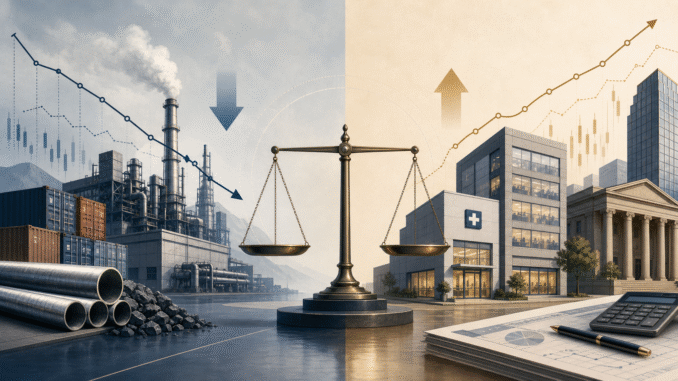
The latest U.S. producer-price data look reassuring at first glance. Prices received by domestic producers fell 0.3% in June, the first monthly decline after increases in April and May. But the headline number hides a meaningful split: goods prices dropped sharply while services prices continued to move higher.
That distinction matters because companies do not all face the same inflation environment. A manufacturer that buys cheaper inputs may get some relief, while a business-heavy economy still has to absorb rising costs for services such as healthcare, finance, transport, legal work and other professional support. Whether that pressure is passed on to customers, absorbed in margins or reflected in wages will help shape the next phase of inflation.
What the June data actually showed
The Bureau of Labor Statistics said its Producer Price Index for final demand fell 0.3% in June on a seasonally adjusted basis. Final-demand goods prices declined 1.4%, while final-demand services prices increased 0.2%.
The annual comparison was less benign. Final-demand prices were 5.5% higher than a year earlier. The index for final demand less foods, energy and trade services—a useful, though not identical, measure of underlying producer-price pressure—rose 0.1% in June.
The goods decline was influenced by a 6.4% fall in final-demand energy prices. That can reduce costs for some producers and distributors, but energy is volatile and does not describe the full pricing environment faced by businesses.
Services offered the more persistent signal. Prices for final-demand services excluding trade, transportation and warehousing rose 0.1%. Within the June release, prices increased for several business and consumer services, including inpatient care, securities brokerage and related services, and loan services.
The numbers therefore do not say that inflation has disappeared. They say that price pressure is moving unevenly through the production chain.
Why goods and services can move in opposite directions
Goods prices respond relatively quickly to inventory, commodity and shipping conditions. When energy costs fall or supply improves, manufacturers and wholesalers may see immediate relief. Those savings can eventually reach retailers and consumers, although the timing and size of the pass-through vary.
Services are different. Their largest cost is often labour, rent, financing or specialised capacity rather than a physical input traded daily in global markets. Prices may adjust through contracts or wage cycles, making them slower to fall even when goods inflation cools.
This is why a softer goods reading should not automatically be interpreted as a broad easing in business costs. A restaurant, clinic, software provider, transport company or financial firm may experience little direct benefit from cheaper energy if payroll and other operating costs continue to rise.
The PPI also measures prices from the seller’s perspective. It is not a direct forecast of the Consumer Price Index, because the two indexes cover different baskets and stages of the economy. Still, producer prices can influence future consumer prices when businesses pass changes in costs through to final prices.
The margin question for companies
For investors, the practical issue is not simply whether producer prices rose or fell. It is how the change interacts with each company’s pricing power and cost structure.
Companies with falling input costs and stable selling prices may see a temporary improvement in gross margins. That is most plausible where lower commodity or energy costs feed quickly into production. But a business with labour-intensive operations may see the opposite: service expenses keep rising while customers resist higher prices.
Three questions are especially useful when reading company results:
- Which costs are actually falling? A lower aggregate PPI may not help a company if its main expenses are wages, rent, cloud services or regulated inputs.
- Can the company pass costs through? Contract structures and customer demand determine whether higher service costs reach prices.
- Is the change temporary? Energy and other goods prices can reverse quickly, while service-price changes may persist for longer.
The answers will differ by sector. A headline PPI decline is not a universal margin tailwind.
What this means for interest-rate expectations
Producer prices are one input into the inflation outlook, not a standalone policy signal. The Federal Reserve also watches consumer prices, wages, employment, demand and broader financial conditions. A single month of lower goods prices is unlikely to settle the policy debate, particularly when services and annual price growth remain elevated.
The June release does, however, reinforce a familiar policy challenge: inflation can cool in one part of the economy while remaining sticky in another. If goods disinflation continues, it could help the overall inflation rate. If services prices keep rising, the improvement may be slower and less uniform than the headline suggests.
That is why markets can react to a soft inflation number and still remain sensitive to later services, wage or demand data. The question is not only whether prices are lower this month, but whether the underlying process is becoming more durable.
What households and investors should watch next
For households, the release is not a reason to expect an immediate drop in everyday prices. Producer-price movements can take time to reach retail shelves, and many services are priced through contracts or local market conditions. A lower energy component may provide some relief, but it does not guarantee lower total spending.
For investors, the next useful evidence will come from three places:
- company earnings calls, where management teams describe input costs and pricing decisions;
- upcoming consumer-price and personal-consumption data, which show how much producer pressure is reaching households; and
- employment and wage data, which help explain why services costs remain firm.
The most balanced reading of June’s PPI is therefore neither “inflation is back” nor “inflation is over.” Goods prices provided welcome relief, but services costs continued to rise. That combination points to an economy in which the direction of inflation is improving in some channels while remaining difficult in others.
Key takeaways
- U.S. final-demand producer prices fell 0.3% in June, but the 12-month increase remained 5.5%.
- Goods prices dropped 1.4%, helped by a 6.4% fall in final-demand energy prices.
- Services prices rose 0.2%, showing that business-cost pressure remains uneven.
- A lower headline PPI does not automatically mean wider profit margins or lower consumer prices.
- The next signal to watch is whether service-price pressure broadens or begins to moderate.