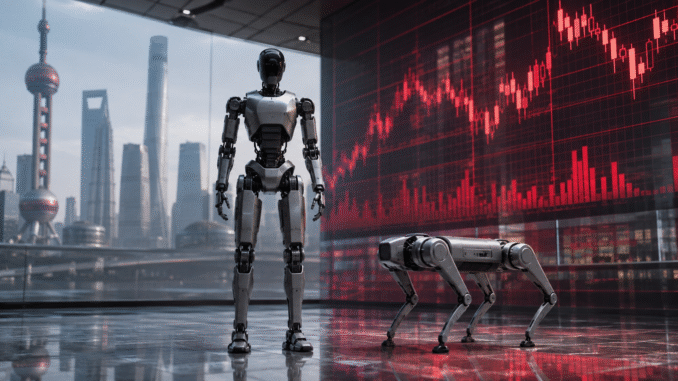
Unitree’s stock-market debut has given China’s humanoid-robotics industry a highly visible public valuation—and an equally visible test of whether commercial progress can catch up with investor expectations.
The Hangzhou-based maker of humanoid and quadruped robots listed on Shanghai’s STAR Market on 19 August 2026 under ticker 688836. Its shares were priced at RMB150.80, opened at RMB1,100 and closed at RMB845, a first-day gain of about 460%. At the closing price, Unitree was valued at roughly RMB342 billion, or about US$50 billion.
That debut matters beyond one company. It turns Unitree into a listed proxy for several of China’s most ambitious themes at once: artificial intelligence moving into physical machines, domestic high-end manufacturing, lower-cost robotics and the country’s attempt to build internationally competitive technology platforms.
The excitement is understandable. The valuation is harder to justify without assuming that humanoid robots move rapidly from demonstrations, research laboratories and data collection into repeatable, economically useful work.
A landmark listing for China’s robotics sector
Unitree sold approximately 40.45 million shares, equal to 10% of its enlarged share capital, at RMB150.80 each. The offer raised about RMB6.1 billion before expenses, according to Shanghai Stock Exchange information.
Demand was intense. Retail subscriptions reportedly exceeded the shares available by more than 8,000 times. The first-day surge was therefore not simply a verdict on Unitree’s current earnings. It was a market vote on the possibility that embodied AI—software that allows machines to perceive, reason and act in the physical world—could become the next major technology platform after generative AI.
Unitree has strong credentials for that narrative. Founded in 2016 by Wang Xingxing, the company became known first for relatively affordable quadruped robots and later for humanoid models capable of running, dancing and performing complex movements. More importantly for investors, it has moved beyond prototypes and generated meaningful sales.
The company’s revenue rose from RMB123 million in 2022 to approximately RMB1.71 billion in 2025, according to its prospectus. Humanoid-robot revenue reached roughly RMB868 million in 2025 and overtook quadruped-robot revenue for the first time. Unitree sold more than 5,500 humanoid robots and about 23,000 quadruped robots during the year.
This is a stronger commercial starting point than many early-stage robotics businesses can show. Unitree also reported adjusted net profit of around RMB600 million for 2025, distinguishing it from peers that remain heavily loss-making.
The valuation has moved far ahead of present revenue
The IPO price implied a post-offering market capitalisation of roughly RMB61 billion. Even that was equivalent to about 36 times 2025 revenue. The first-day closing value of approximately RMB342 billion pushed the multiple to around 200 times trailing revenue.
A price-to-sales ratio is an imperfect measure for a fast-growing hardware and software company, particularly when margins and product mix are changing quickly. But a multiple of that scale carries a clear message: investors are valuing Unitree on a much larger future market, not on its present business.
For the valuation to become less demanding, several things would need to happen together. Unit sales must continue rising rapidly; gross margins must remain resilient as competition increases; recurring software, services or maintenance income must become more meaningful; and robots must prove that they can perform economically valuable tasks outside controlled demonstrations.
This is the central tension. Unitree is no longer merely a promising startup, but neither has humanoid robotics reached mass-market maturity.
What the headline numbers do—and do not—prove
Unitree’s 2025 growth was exceptional. Humanoid revenue increased sharply, helped by broader public visibility, a wider product range and demand from universities, research institutions and companies developing embodied-AI systems.
Those customers are valuable because they expand the developer ecosystem and generate training data. They do not necessarily prove that humanoid robots can yet replace or augment labour at scale in factories, warehouses, hospitals or homes.
Industry filings suggest that a large share of current humanoid demand remains linked to research, education, exhibitions and data collection. Industrial applications such as manufacturing, inspection and logistics are developing, but their contribution is still comparatively small. The market is therefore buying an option on future productivity rather than a fully demonstrated productivity tool.
The distinction matters because visually impressive movement is not the same as dependable work. Commercial robots must combine perception, dexterity, safety, battery life, uptime and low maintenance costs. They must also operate reliably in changing environments where mistakes can damage equipment or injure people.
Hardware economics create another challenge. Lower prices can accelerate adoption and give Unitree a scale advantage, but they can also compress margins. China’s robotics supply chain may help reduce component costs, yet intense competition from domestic rivals could transfer much of that benefit to customers.
Why China may still have an important advantage
China offers a particularly favourable environment for turning robotics research into manufactured products. It has deep supply chains in motors, batteries, sensors, electronics and precision components, as well as a large manufacturing base where robots can be tested.
Scale can create a reinforcing cycle. More units in the field generate more operating data; more data can improve control systems and AI models; better performance can expand the range of viable tasks; and higher volumes can reduce unit costs.
Policy support is another tailwind. Robotics and embodied intelligence fit China’s priorities around advanced manufacturing, technological self-reliance and productivity. The country also has a structural reason to pursue automation as its working-age population declines and labour costs rise.
Yet policy alignment should not be confused with guaranteed shareholder returns. Subsidies, procurement and industrial support can speed development, but they can also encourage excess capacity and aggressive competition. China’s electric-vehicle and solar industries show how rapid scaling can coexist with price wars and pressure on profitability.
Global opportunity meets geopolitical risk
Unitree’s low-cost products have helped it build an international profile, and overseas sales remain an important part of the business. That creates both growth potential and vulnerability.
Chinese robotics companies face rising scrutiny over data security, dual-use capabilities and dependence on foreign semiconductors and AI hardware. Restrictions in the United States or other markets could limit access to customers, components, computing technology or partnerships.
These risks do not eliminate Unitree’s domestic opportunity, but they may affect the size and profitability of its addressable global market. Investors should also watch whether overseas restrictions encourage separate technology ecosystems, forcing Chinese robotics companies to redesign components or software around domestic suppliers.
What the IPO means for investors and competitors
For investors, Unitree provides rare direct exposure to a fast-growing robotics manufacturer. It also makes comparison easier. Future quarterly results will reveal product mix, margins, research spending, overseas exposure and the pace at which industrial customers move from trials to repeat orders.
For competitors, the listing creates a powerful source of capital and a public valuation benchmark. A high share price could help Unitree recruit talent, fund research and pursue acquisitions. It may also accelerate IPO plans across China’s embodied-AI sector.
That can benefit suppliers of actuators, sensors, reducers, batteries and industrial software. But “picks and shovels” companies are not automatically safer investments. Their returns will depend on customer concentration, pricing power, capacity discipline and whether industry volumes expand fast enough to absorb new supply.
What to Watch
Four indicators will help separate durable commercial progress from market enthusiasm:
- Customer mix: Growth in repeat orders from factories, logistics operators and other end users would be more meaningful than one-off research or exhibition demand.
- Margins and cash flow: Rapid revenue growth is less valuable if price competition, warranty costs and working-capital needs consume the economics.
- Software capability: Improvements in autonomy, task generalisation and safe operation will determine whether the hardware becomes genuinely useful.
- Geopolitical exposure: Export restrictions, component controls and security rules could reshape Unitree’s international prospects.
Investors should also watch the stock’s behaviour after the initial scarcity effect fades. First-day IPO prices can be driven by limited float, subscription mechanics and momentum rather than a settled estimate of long-term value.
Finance World’s Read
Unitree’s IPO is a genuine milestone for China’s robotics industry. The company has real products, rapid revenue growth, manufacturing scale and a record of making sophisticated robots more affordable. It deserves to be taken more seriously than a speculative concept company.
But the debut valuation prices in far more than technological promise. It assumes that humanoid robots will soon develop reliable economic use cases, that Unitree will retain a leading position as competition intensifies, and that margins will survive the transition from premium early demand to mass adoption.
The most useful conclusion is therefore neither that the debut was irrational nor that it proves a new industrial era has arrived. Unitree has given public investors a way to participate in embodied AI—but at a price that makes execution, not imagination, the decisive variable.
Information is current as of 20 August 2026. This article is for general information only and does not constitute investment advice.
Sources
- Shanghai Stock Exchange: Unitree company and listing information
- Shanghai Stock Exchange: Unitree IPO attracts attention to China’s robotics sector
- Unitree IPO prospectus
- China Securities Regulatory Commission: approval of Unitree’s IPO registration
- Reuters: Unitree surges in Shanghai debut
- Reuters: China robot makers seek a path to mass adoption