U.S. durable-goods orders edged higher in June, but the modest headline concealed a much stronger pocket of demand. New orders for long-lasting manufactured goods rose 0.3% to $334.8 billion, according to the U.S. Census Bureau. Excluding transportation equipment, orders increased 0.6%.
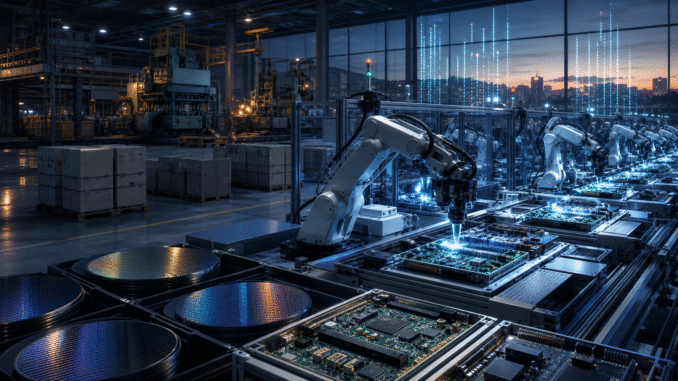
The category that led the advance was computers and electronic products. Orders there rose 3.1%, or $0.9 billion, to $31.1 billion—its ninth increase in ten months.
That split matters. It suggests that businesses are still committing money to technology and electronic equipment even as the wider manufacturing picture remains restrained. For markets, the report is less a signal of a broad industrial acceleration than evidence that capital spending remains concentrated in a few technology-heavy areas.
A modest headline after a volatile month
The 0.3% increase followed a 4.0% decline in May. Durable-goods figures can swing sharply from month to month because large aircraft and defence orders are uneven, so investors often look past the total and examine measures that remove transportation or defence.
June's details were firmer on both counts. Orders excluding transportation rose 0.6%, while orders excluding defence increased 0.3%. The figures do not point to a manufacturing boom, but they do show that the gain was not entirely the result of one unusually large transport contract.
Computers and electronics provided the clearest source of momentum. That category includes a broad range of equipment and components, so it should not be treated as a clean measure of artificial-intelligence spending. Still, its persistent rise fits a wider pattern: investment related to computing infrastructure is running ahead of the economy's more general capital-spending cycle.
The less-obvious detail: investment is not the same as broad productivity
The Federal Reserve recently described the U.S. economy as being in an AI “buildout phase.” Its researchers noted that spending on data centres, servers, networking equipment and software has contributed meaningfully to growth, while evidence of a broad transformation in productivity and employment remains limited.
That distinction helps explain why strong technology orders can coexist with a less impressive overall factory headline. Companies building computing capacity must purchase equipment well before the benefits appear in economy-wide output. Physical infrastructure, chips, power systems and software are installed first; adoption, workflow redesign and measurable productivity gains can take longer.
The June orders report therefore says more about where businesses are placing capital than about how much payoff the economy has already received.
It also highlights a measurement problem. Computers and electronic products include ordinary corporate equipment and non-AI uses. Some data-centre capacity is leased rather than owned, while a meaningful share of computing equipment is imported. A rise in orders can signal genuine demand without translating one-for-one into domestic production, corporate profit or gross domestic product.
What it means for companies and markets
For technology suppliers, the data support the view that demand for computing and electronic equipment remains active. But the benefit is unlikely to be distributed evenly. Hardware producers, component suppliers, data-centre contractors and power-equipment businesses sit at different points in the investment chain, with different margins, financing needs and exposure to imported inputs.
For industrial companies outside technology, the report is more cautious. A 0.3% total increase after May's decline does not show a broad surge in factory demand. Businesses may still be selective about large commitments while borrowing costs remain elevated and the economic outlook is uncertain.
For investors, the key question is whether concentrated capital spending begins to spread. A durable expansion would normally become visible across more categories, through rising shipments, growing backlogs and sustained orders beyond computers and electronics. If investment remains narrow, market performance may continue to depend heavily on a relatively small group of technology-linked companies.
There is also a cash-flow trade-off. Heavy capital expenditure can support future capacity and revenue, but it consumes cash today. The economic case improves only if the new assets achieve high utilisation and generate productivity or pricing benefits. Rising orders are evidence of commitment, not proof of returns.
What to watch next
Three indicators will help clarify whether June's technology-led strength is becoming broader.
First, unfilled orders and shipments will show whether factories are converting demand into production or merely accumulating backlogs. Second, future data on non-residential investment will indicate whether spending is spreading beyond computing equipment into other productive assets. Third, company earnings will reveal whether capital spending is producing revenue growth and efficiency gains—or simply raising depreciation, energy and financing costs.
The durable-goods report offers a useful snapshot: U.S. businesses are still spending, but they are not spending uniformly. Technology equipment is doing much of the lifting. The next stage of the story depends on whether that investment produces wider gains in productivity and demand.
Sources
- U.S. Census Bureau: Monthly Advance Report on Durable Goods Manufacturers’ Shipments, Inventories and Orders, June 2026
- Federal Reserve: The AI Buildout and the Economy—Publicly Available Data to Assess AI’s Impact
This article is for general informational purposes only and does not constitute investment advice.