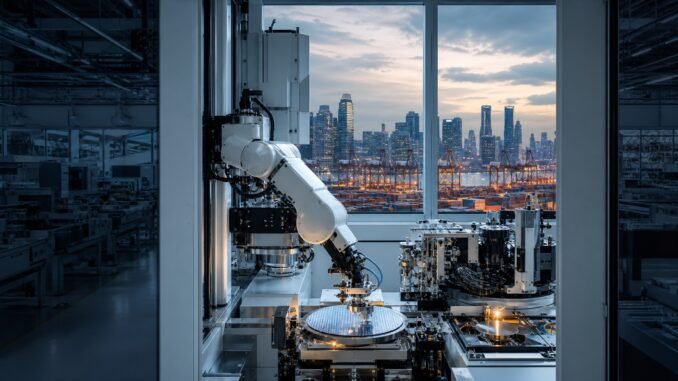
Singapore’s economy expanded by 5.7% from a year earlier in the second quarter of 2026, a pace that would normally signal broad strength. The more revealing number, however, was manufacturing’s 12.2% surge.
That industrial expansion was driven largely by electronics and precision engineering as global investment in artificial intelligence lifted demand for semiconductors and chipmaking equipment. Chemicals and biomedical manufacturing contracted.
The distinction matters. Singapore is benefiting from one of the strongest investment cycles in the global economy, but the headline GDP figure is carrying a more concentrated engine than it first appears. For investors and businesses, the question is not simply whether growth is fast. It is how durable, broad and repeatable that growth will be if the AI hardware cycle changes.
A Strong Quarter, Led by Manufacturing
The Ministry of Trade and Industry’s advance estimate showed that GDP grew 5.7% year on year in the second quarter, easing from 6.3% in the first quarter. On a seasonally adjusted quarter-on-quarter basis, output rose 1.1%, extending a 1.3% increase in the previous quarter.
Manufacturing was the standout. The sector expanded 12.2% from a year earlier and 5.3% from the previous quarter on a seasonally adjusted basis. MTI attributed the strength mainly to electronics and precision engineering, supported by AI-related demand for semiconductors and semiconductor manufacturing equipment.
Trade data points in the same direction. Enterprise Singapore reported that non-oil domestic exports rose 20.7% year on year in June. Electronics exports continued to surge, driven mainly by integrated circuits, disk media products and personal computers. Non-electronics exports declined.
Non-oil re-exports rose 60.3%, while total merchandise trade expanded 49.3%. Those figures reinforce Singapore’s role as both a manufacturing base and a regional trading hub for the electronics supply chain.
Why the AI Link Is Economically Important
AI demand reaches Singapore through more than finished chips.
The country produces semiconductors, hosts equipment makers, performs testing and packaging, supports precision-engineering suppliers and moves components through a major logistics network. Singapore’s Economic Development Board says the country accounts for about one-tenth of global chip production and one-fifth of semiconductor equipment production.
That makes the current AI capital-spending cycle unusually relevant. When chipmakers expand fabrication capacity and invest in more advanced production, the benefits can flow to equipment, components, engineering services, logistics and supporting infrastructure.
Recent investments illustrate the link. Applied Materials opened an expanded manufacturing and research campus in Singapore in June to support the global build-out of AI infrastructure. The company said the US$500 million facility more than doubled its advanced cleanroom capacity in the country.
These projects can create high-value activity and deepen industrial capabilities. They may also strengthen Singapore’s position in a supply chain that governments and companies increasingly view as strategic.
But exposure to a powerful theme is not the same as insulation from a cycle.
The Headline Hides Uneven Performance
MTI’s advance estimate showed chemicals and biomedical manufacturing contracting in the second quarter. Chemicals were affected by feedstock disruptions linked to the Middle East conflict, while other data has shown weakness in parts of biomedical manufacturing.
The May manufacturing report offered a clearer picture of the divergence. Electronics output grew 35.8% and precision engineering rose 32.2%. Chemicals fell 11.5%, biomedical manufacturing declined 24.2% and transport engineering output fell 5.0%.
That spread is important because aggregate growth can look robust even when several industries are weakening. A concentrated upswing may still be economically valuable, but it can create different realities for workers, suppliers and investors depending on where they sit.
It also explains why MTI maintained a more cautious full-year growth forecast of 2% to 4% in May, despite strong first-quarter performance. The ministry pointed to heightened external risks, including geopolitical conflict. The second-quarter advance estimate confirms the economy had substantial momentum, but it does not eliminate those risks.
Three Tests of Durability
The first test is whether AI demand remains tied to usable investment rather than increasingly optimistic expectations.
Semiconductor demand can be volatile because customers order ahead of anticipated needs, inventories move across the supply chain and expensive fabrication projects take years to complete. If data-centre operators keep expanding capacity and chipmakers maintain capital spending, Singapore’s equipment and electronics ecosystem may remain well supported. If investment slows, the same operating leverage can work in reverse.
The second test is whether strength spreads beyond electronics.
Broad growth would be more resilient than a boom carried by a few clusters. A recovery in chemicals, biomedical manufacturing and transport engineering would reduce dependence on one global capital-spending theme. Continued contraction in those areas would leave the headline increasingly sensitive to semiconductor demand.
The third test is whether export growth reflects sustainable end demand.
June’s 20.7% increase in non-oil domestic exports was impressive, but it slowed from 38.4% in May. Re-exports grew much faster than domestic exports, showing the importance of trade intermediation. Investors should watch the mix of products and destinations, not just the total, because inventory shifts and supply-chain timing can produce large monthly changes.
What This Means for Investors and Businesses
For investors in Singapore-listed companies, the GDP figure should be a starting point rather than a blanket signal.
Businesses exposed to semiconductor equipment, industrial automation, logistics and data-centre infrastructure may benefit from the AI investment cycle. The relevant questions are whether that demand converts into recurring revenue, stronger margins and cash generation—and whether current valuations already assume an extended boom.
Banks may benefit indirectly from healthy business activity and investment, but the gains depend on loan demand, credit quality and funding conditions. Industrial property and logistics assets can also benefit from capacity expansion, although investors still need to assess tenant concentration, development supply and financing costs.
For businesses, the lesson is similar. Strong national growth does not guarantee strong demand in every sector. Companies should distinguish structural opportunity from temporary order strength, avoid building fixed costs around a single optimistic scenario and examine how exposed their suppliers and customers are to the same technology cycle.
For households, the effects will be uneven. Advanced manufacturing can support high-skilled engineering, technical and operational roles, but it does not automatically lift employment or wages across the entire economy. The durability of the expansion will be clearer when labour-market and income data show whether gains are spreading.
What to Watch Next
Several indicators can show whether Singapore’s growth is broadening or becoming more concentrated:
- The final second-quarter GDP release and any revisions to sector contributions.
- Monthly electronics and precision-engineering output.
- Non-electronics exports and the composition of re-exports.
- New orders, inventories and capital-spending guidance from global chipmakers and equipment suppliers.
- Recovery or further weakness in chemicals and biomedical manufacturing.
- Employment, wage and productivity trends across manufacturing and services.
- Energy and feedstock conditions affected by geopolitical disruption.
No single release will settle the outlook. The most useful signal will be whether several independent parts of the economy begin moving in the same direction.
Finance World’s Read
Singapore’s second-quarter performance is genuinely strong. A 5.7% expansion, backed by double-digit manufacturing growth and surging electronics trade, shows that the country is capturing real economic value from the global AI infrastructure build-out.
The qualification is breadth.
Electronics and precision engineering are doing much of the heavy lifting while chemicals, biomedical manufacturing and non-electronics exports show a weaker picture. That does not invalidate the growth story, but it changes how the headline should be interpreted.
The best outcome would be for AI-linked demand to remain firm while recovery spreads to other industries. The risk is that a narrow technology cycle is mistaken for a uniformly strong economy.
Singapore has an unusually valuable position in the semiconductor supply chain. The next test is whether that advantage becomes a bridge to broader growth—or remains a powerful but concentrated engine.
Sources
- Singapore Ministry of Trade and Industry: Singapore’s GDP Grew by 5.7 Per Cent in the Second Quarter of 2026
- Enterprise Singapore: Singapore’s External Trade — June 2026
- Singapore Economic Development Board: Monthly Manufacturing Performance — June 2026
- Singapore Economic Development Board: Monthly Manufacturing Performance — May 2026
- Singapore Economic Development Board: Applied Materials Expands Singapore Manufacturing for AI
- Singapore Ministry of Trade and Industry: MTI Maintains 2026 GDP Growth Forecast at 2.0% to 4.0%
This article is for general informational purposes only and does not constitute financial, investment, tax or legal advice.