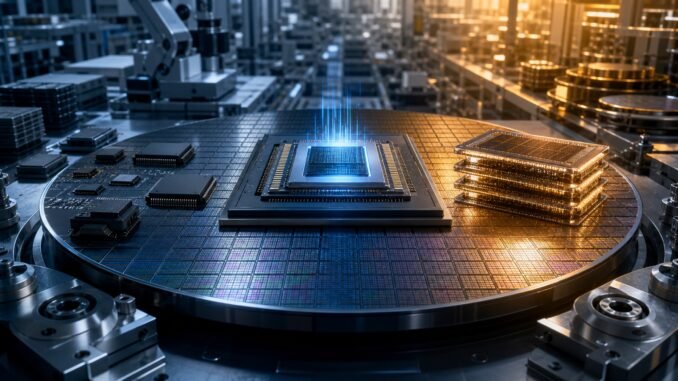
The global semiconductor industry is expanding at a pace that would have looked implausible only a few years ago. World Semiconductor Trade Statistics said first-half 2026 sales reached $702 billion, more than double the level a year earlier, as artificial-intelligence infrastructure, high-performance computing and advanced memory drove exceptional demand.
But the headline number conceals the most important fact for investors and businesses: this is not one uniform chip cycle. It is a two-speed market. Advanced logic and memory are racing ahead, while many mature-node, consumer, automotive and industrial categories face different demand conditions, inventory positions and pricing power.
That distinction matters because a rising industry total does not automatically translate into equally strong economics for every chip designer, foundry, equipment maker or end market.
Memory is doing much of the heavy lifting
WSTS reported that memory sales grew 305% year over year in the first half of 2026, compared with 45% growth for logic. The organisation’s mechanical update—substituting actual second-quarter results into its spring assumptions—put the full-year market at roughly $1.66 trillion, up about 108%.
Those figures describe an extraordinary expansion, but they should be interpreted carefully. WSTS explicitly said the calculation was not a newly constructed forecast scenario. It retained the original assumptions for the second half, so it is better read as an indication of the first-half run-rate than a guarantee that the same momentum will persist.
The mix also matters. High-bandwidth memory, advanced processors and leading-edge foundry capacity sit at the centre of the AI build-out. These products command far higher values than many conventional chips. Rapid gains in prices and product mix can therefore push industry revenue sharply higher without implying that unit demand has doubled across the entire market.
For readers, the practical lesson is simple: “semiconductor growth” is too broad to be a complete investment thesis. The relevant questions are which products are growing, whether the gain comes from units or pricing, and how durable the end demand may be.
The capital-spending signal is powerful
Company results reinforce the picture of intense demand at the advanced end of the supply chain.
TSMC reported second-quarter 2026 revenue of $40.2 billion and a 67.7% gross margin. Its third-quarter guidance called for revenue of $44.6 billion to $45.8 billion. Earlier in the year, the foundry said it expected its 2026 capital budget to be toward the high end of a $52 billion to $56 billion range, largely to support leading-edge demand.
ASML, whose lithography systems are essential to advanced chipmaking, reported second-quarter net sales of €9.3 billion and raised its 2026 sales outlook to €43 billion–€45 billion. It also outlined plans to increase capacity for both low numerical-aperture extreme-ultraviolet systems and deep-ultraviolet immersion systems in 2027.
These are not merely optimistic presentations. They are large, concrete commitments involving factories, tools, engineers and supplier capacity. They indicate that major manufacturers expect the AI infrastructure cycle to require more physical production capacity over several years.
Yet capital expenditure is also where risk accumulates. Semiconductor plants are expensive, take years to build and cannot be adjusted as quickly as software spending. If customer demand, chip prices or financing conditions weaken before new capacity earns an acceptable return, today’s shortage can become tomorrow’s overcapacity.
Why the rest of the market can look different
The semiconductor industry serves many customers besides AI data centres. Smartphones, personal computers, cars, industrial equipment, appliances and communications devices use large volumes of chips, often produced on mature processes.
These markets do not share one cycle. A data-centre customer may be competing for advanced accelerators and high-bandwidth memory while an automotive supplier works through inventory in microcontrollers, or a consumer-electronics manufacturer remains sensitive to component costs and household demand.
TSMC itself has warned that rising component prices can pressure consumer and price-sensitive end markets. That illustrates a feedback loop inside the boom: expensive memory and advanced components improve revenue for suppliers, but they can also raise the cost of finished devices and constrain demand elsewhere.
A broad sales record can therefore coexist with weaker conditions in selected mature categories. The industry’s aggregate growth rate is real, but concentration makes it a less reliable measure of health than it first appears.
Who may benefit—and who carries the risk
The most direct beneficiaries are companies with scarce capabilities in advanced manufacturing, lithography, packaging, memory and the specialised materials required to connect them. Scarcity can support pricing power and high utilisation, particularly when customers are trying to secure capacity years in advance.
But strong industry demand does not remove company-specific risk. Equipment suppliers depend on a relatively small number of large customers. Foundries must fund enormous capital programmes. Memory producers operate in a market with a long history of price cycles. Chip designers face rapid product transitions, customer concentration and the possibility that buyers develop alternatives.
Valuation adds another layer. A company can deliver strong revenue and margins yet disappoint investors if its share price already assumes several years of near-perfect execution. Conversely, a slower-growing mature-chip business may offer steadier cash flow but less exposure to the AI spending surge. Business quality and investment value remain separate questions.
The effects extend beyond listed semiconductor companies. Cloud providers must earn returns on the infrastructure they are buying. Electricity networks, data-centre operators and cooling providers face the physical consequences of expansion. Electronics manufacturers may contend with higher component costs, while governments are spending heavily to localise supply chains and reduce strategic dependence.
What to watch next
Four indicators will help determine whether the boom is broadening or becoming more fragile:
- Memory pricing and supply discipline. If prices rise mainly because supply remains tight, new capacity could eventually test margins.
- Advanced packaging availability. Bottlenecks in packaging can limit shipments even when wafers are available.
- Demand outside AI infrastructure. A recovery in automotive, industrial and consumer categories would make the expansion more balanced.
- Capital-spending returns. The decisive test is whether customers can convert AI investment into sustainable revenue and cash flow before capacity catches up.
Policy also matters. Export controls, tariffs, subsidies and geopolitical tension can redirect capacity and raise duplication costs. They may improve resilience in some regions while reducing the efficiency of the global supply chain.
Finance World’s Read
The semiconductor boom is supported by unusually strong evidence: record sales, high margins, rising capacity commitments and sustained demand for advanced computing. It should not be dismissed as a purely speculative narrative.
However, the market’s strength is concentrated. Memory and advanced logic are expanding far faster than the industry’s slower segments, and revenue growth is being amplified by mix and pricing. That makes the headline total less informative than the distribution of demand underneath it.
The most useful framework is not to ask whether semiconductors are booming. It is to ask where scarcity persists, who must fund the next wave of capacity, and whether end customers can earn enough from AI infrastructure to sustain the spending cycle. The answer will determine whether today’s two-speed expansion becomes a durable broadening—or another capital-intensive peak.
Information is current as of 25 August 2026. This article is for general information and does not constitute personalised financial advice.