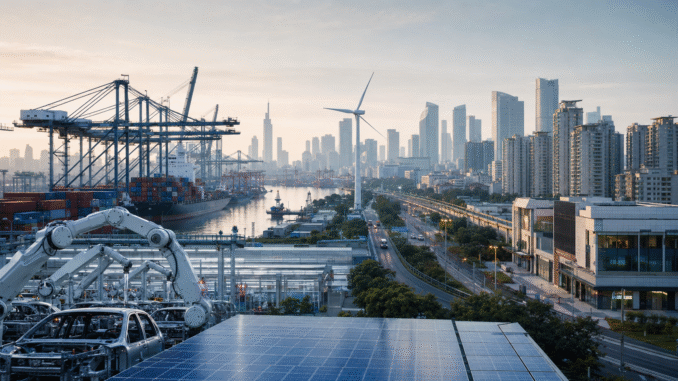
China’s economy is still expanding at a pace many large economies would envy. Yet the latest figures also reveal a widening gap between the engines keeping growth afloat and the parts of the economy that households and private businesses feel most directly.
Gross domestic product increased 4.7% year on year in the first half of 2026, according to China’s National Bureau of Statistics (NBS). That puts growth within reach of Beijing’s full-year target of 4.5% to 5%, but it also marks a slowdown from 5.0% in the first quarter and from the 5.0% recorded for 2025.
The headline is therefore neither collapse nor a clean acceleration. China has a resilient but increasingly two-speed economy: exports, advanced manufacturing and selected services are supporting activity, while consumption, property and private investment remain subdued.
Information in this article is current as of 29 July 2026.
The Headline Growth Rate Masks a Sharp Internal Divide
The first-half data show services expanding 5.2%, faster than the 3.9% growth of the secondary sector. Innovation-linked industries have also remained a source of strength. Earlier first-quarter figures showed rapid production growth in industrial robots, lithium-ion batteries and 3D-printing equipment, illustrating how investment in higher-value manufacturing continues to reshape the economy.
Trade has provided another powerful lift. In the first half, the value of goods exports rose 13.4% year on year, while imports increased 22.1%. Total goods trade was up 16.9%.
Those figures show that China remains deeply competitive in global manufacturing and supply chains. They also complicate the common narrative that the economy is simply stagnating. In areas such as machinery, electronics, clean energy and industrial automation, China is still adding capacity, developing technology and reaching overseas customers.
But the domestic side of the economy looks much less energetic.
Retail sales rose only 1.0% year on year in June. Fixed-asset investment fell 5.7% in the first half, and it was still down 2.7% even after excluding property development. That is a striking deterioration from the first quarter, when fixed-asset investment had risen 1.7%.
The direction of travel matters: growth is being sustained, but its composition remains unbalanced.
Why Consumption Is Still the Missing Engine
For years, policymakers and economists have argued that China needs to rely more on household consumption and less on property, infrastructure and investment-led growth. That transition is proving difficult.
Weak consumer spending is not simply a matter of temporary caution. It reflects deeper constraints: uncertainty over employment and income, an ageing population, high precautionary saving and the negative wealth effect created by falling property values. When a household’s largest asset is losing value, it is rational to save more and spend less.
Services consumption has generally performed better than goods spending, suggesting that demand has not disappeared altogether. Tourism, communication and leisure-related activity have shown pockets of resilience. But this has not yet translated into the broad, self-sustaining consumption cycle needed to replace the old property-led model.
The World Bank’s July 2026 China Economic Update projects growth of 4.4% this year and argues that persistent domestic-demand headwinds remain the central challenge. Its report is tellingly titled “Rebalancing Growth”: the issue is not merely how much China grows, but whether household demand can play a larger role in generating that growth.
Property Remains the Main Structural Drag
China’s property downturn continues to weigh on household confidence, local-government finances, construction activity and demand for materials and household goods.
In the first quarter, real-estate development investment fell 11.2% year on year. The floor area of newly built commercial buildings sold declined 10.4%, while their sales value dropped 16.7%. The latest first-half fixed-investment figure suggests that weakness has spread beyond a narrow housing adjustment.
Property matters because its influence extends well beyond developers. Local governments have historically relied on land sales. Banks are exposed through mortgages and lending to developers and related businesses. Construction supports steel, cement, appliances and employment. Falling home prices can also make families feel poorer even when their incomes have not changed.
Policy support can reduce the risk of a disorderly correction, but stabilisation is not the same as returning to the previous model. Recreating another debt-fuelled building boom would postpone rather than solve the need to rebalance the economy.
Exports Are a Strength—and a Source of Risk
The export surge is helping offset domestic weakness, but it creates a second tension.
China’s manufacturing competitiveness is genuine. Strong infrastructure, dense supplier networks, skilled labour and scale allow companies to compete across a wide range of products. The shift toward electric vehicles, batteries, solar equipment, automation and advanced machinery has also generated new areas of growth.
However, an economy that relies heavily on exports becomes more exposed to overseas demand, tariffs and trade disputes. Strong Chinese supply can provoke protectionist responses when trading partners believe their own producers are being displaced. It can also intensify price competition and compress manufacturers’ profit margins.
The International Monetary Fund forecast in April that China would grow 4.4% in 2026 before slowing to 4.0% in 2027, citing housing weakness, a declining labour force, lower returns on investment and slower productivity growth as structural headwinds. That forecast underlines why export strength alone cannot resolve the domestic adjustment.
What the Policy Response Needs to Achieve
Beijing has set a 2026 growth target of 4.5% to 5% and signalled support for consumption, innovation and economic stability. The first-half result suggests that the lower end remains attainable, especially if external demand holds up.
Yet the quality of stimulus matters more than the size of any single package.
More infrastructure spending can lift activity quickly, but it may add debt and excess capacity. Easier credit can support borrowers, but it cannot force households or firms to take loans when confidence is weak. Property support can prevent destabilising falls, but it should not recreate expectations that housing prices only move upward.
Policies that strengthen household disposable income and financial security may have a more durable effect. Better social protection, healthcare and pension coverage can reduce precautionary saving. Measures that improve private-sector confidence and market access can encourage hiring and investment. A credible resolution of unfinished housing projects would also help restore trust.
The difficult part is that these reforms redistribute resources toward households and private businesses, making them more structural—and politically complex—than a conventional investment stimulus.
Implications for Investors and Businesses
For investors, China should not be treated as a single macro trade. The divide between external manufacturing strength and weak domestic demand creates sharply different conditions across sectors.
Export-oriented technology and industrial companies may benefit from scale and policy support, but they face tariff, pricing and overcapacity risks. Consumer businesses may offer long-term potential, yet near-term results will depend heavily on household confidence and income growth. Banks and property-linked companies remain sensitive to asset quality, developer stress and local-government finances.
For multinational businesses, China remains too large and industrially capable to ignore. But demand forecasts should be based on sector-level evidence rather than the headline GDP figure alone. Firms exposed to domestic discretionary spending may experience a much weaker economy than exporters or suppliers to strategic industries.
Currency and market outcomes will also depend on policy choices. Stronger fiscal support for households could improve the domestic outlook, while renewed trade friction or a deeper property correction would increase downside risk.
What to Watch Next
Three indicators will show whether the economy is becoming better balanced:
- Retail sales and household income: A sustained improvement would suggest that confidence and purchasing power are recovering.
- Property sales, prices and unfinished projects: Stabilisation would reduce the drag on household wealth and local-government revenue.
- Private investment: A rebound would be stronger evidence of confidence than state-led infrastructure spending alone.
Investors should also watch export volumes, producer prices and industrial profits. Rising shipments are less reassuring if they come with falling prices and thinner margins.
Finance World’s Read
China’s economy is not in free fall. It retains major strengths in manufacturing, technology, infrastructure and trade, and those strengths are supporting respectable growth.
The more important question is whether the economy can generate stronger demand at home without returning to property speculation or increasingly debt-intensive investment. So far, the answer is only partial.
The first-half figures describe an economy capable of meeting a growth target, but not yet one that has completed its transition to a more balanced model. China’s next phase will be judged less by whether GDP grows by 4.4%, 4.7% or 5.0%, and more by whether households gain the confidence and income to become a more durable source of demand.
Sources
- National Bureau of Statistics of China: First-half 2026 economic performance
- National Bureau of Statistics of China: First-quarter 2026 economic performance
- World Bank: China Economic Update, July 2026 — Rebalancing Growth
- IMF: World Economic Outlook, April 2026
- State Council of China: 2026 policy mix and growth target
This article is for general informational purposes only and does not constitute investment, financial or other professional advice.