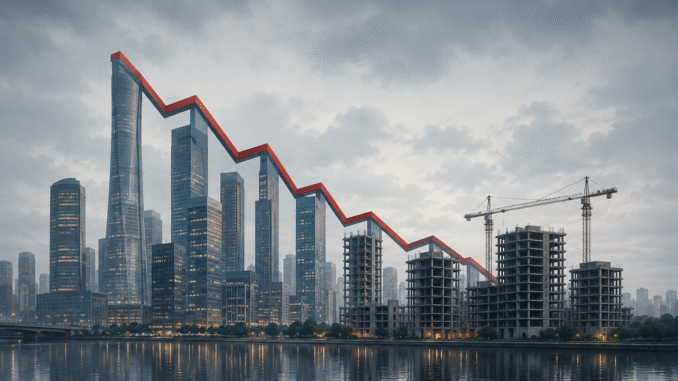
China’s property downturn is no longer simply a developer crisis. It has become a prolonged economic adjustment with consequences for domestic consumption, local-government finances, commodity demand and the country’s long-term growth model.
The latest figures show that the contraction intensified during the first half of 2026. Real-estate development investment fell 18% year over year, compared with an 11.2% decline during the same period of 2025. New construction starts dropped 23.4%, while the value of newly built commercial-property sales declined 13.6%.
Developer financing is deteriorating even faster. Funds available to real-estate developers fell 20.2%, including a 31.7% decline in domestic loans and a 24.9% fall in individual mortgage financing.
For investors, the message is clear: China’s housing market has not yet reached a durable, demand-led recovery.
The contraction is becoming structural
The downturn began as a correction following years of debt-fuelled development. It is increasingly shaped by deeper forces: slower household formation, a declining population, weaker expectations for house-price appreciation and substantial housing supply in lower-tier cities.
The International Monetary Fund estimates that housing investment fell from 12.3% of Chinese GDP in 2020 to 6.1% in 2025. Housing completions were almost 40% below their earlier level.
This makes a return to the previous growth model unlikely. Lower mortgage rates and fewer purchase restrictions may release some pent-up demand, particularly in major cities, but they cannot fully reverse the demographic and confidence-related pressures confronting the sector.
The distinction matters for markets. Policy measures may generate periodic rebounds in sales or property equities without producing a sustained national recovery.
The economic transmission channels
Property affects China’s economy through more than construction.
Falling home prices can weaken household confidence because housing represents a large portion of household wealth. That discourages consumption and complicates policymakers’ effort to rebalance growth toward domestic demand.
Lower land sales and property-related taxes also constrain local governments. Authorities with weaker revenue may reduce infrastructure spending or lean more heavily on borrowing, placing further pressure on already indebted local-government financing vehicles.
The property slowdown also feeds through to industries including steel, cement, construction machinery, household appliances, furniture and building materials. Companies dependent on new residential construction face a more difficult environment than businesses serving renovation, urban renewal or completed-project delivery.
The World Bank expects China’s economic growth to moderate to 4.4% in 2026, citing continuing property adjustment and cautious consumers among the principal domestic headwinds.
What it means for investors
The greatest risk is not necessarily an abrupt financial crisis. China’s state-controlled banking system gives policymakers considerable capacity to manage liquidity and restructure liabilities over time.
The more probable challenge is a drawn-out balance-sheet adjustment that suppresses credit demand, consumption and nominal growth.
That environment favours selectivity.
Large state-owned developers with access to financing and projects in economically stronger cities may continue gaining market share. Highly leveraged private developers, businesses reliant on aggressive presales and companies concentrated in oversupplied regions remain considerably more exposed.
Banks face a mixed picture. Direct mortgage losses may remain manageable, but weaker credit growth, pressure on net interest margins and indirect exposure to developers and local governments could weigh on profitability.
For global investors, weaker Chinese construction activity is also relevant to iron ore, steelmaking coal, copper and construction-equipment demand. Commodity exposure should therefore be evaluated against actual construction and completion data—not only announcements of property support.
Potential beneficiaries include companies involved in affordable housing, urban redevelopment, rental housing, property management and the completion of unfinished projects. Yet policy sponsorship alone is insufficient: investors still need evidence of sustainable cash flows and credible funding.
Signals that would indicate a turning point
A genuine recovery would require more than one month of stronger home sales. Investors should monitor:
- Stabilisation in nationwide sales volumes and prices, extending beyond top-tier cities.
- Improving developer cash flows and access to bank lending.
- A sustained decline in unfinished and unsold housing inventories.
- Evidence that households are becoming more willing to borrow and purchase homes.
- A credible mechanism for restructuring insolvent developers and completing presold projects.
- Stabilisation in land-sale revenue and local-government finances.
The bearish thesis would weaken if sales, prices, mortgage demand and developer funding improved together for several quarters. Conversely, continued declines in new starts and financing would indicate that the sector remains a drag even if headline sales temporarily rebound.
The investment conclusion
China’s property market is becoming smaller as a share of the economy, but that transition is neither complete nor painless.
Policymakers can reduce the risk of disorderly defaults and support project completion. They are less able—and may be unwilling—to recreate the speculative demand and leverage that powered the previous cycle.
Investors should therefore treat property stimulus as a tool for managing contraction, rather than automatic evidence of a new housing boom. The strongest opportunities are likely to emerge from consolidation, restructuring and urban renewal, while the broad macroeconomic effects remain deflationary.
The decisive signal will be a recovery in household demand and developer cash flow. Until both appear, China’s property sector should be viewed as an ongoing restructuring story—not a conventional cyclical rebound.
This article is for general information only and does not constitute investment advice.