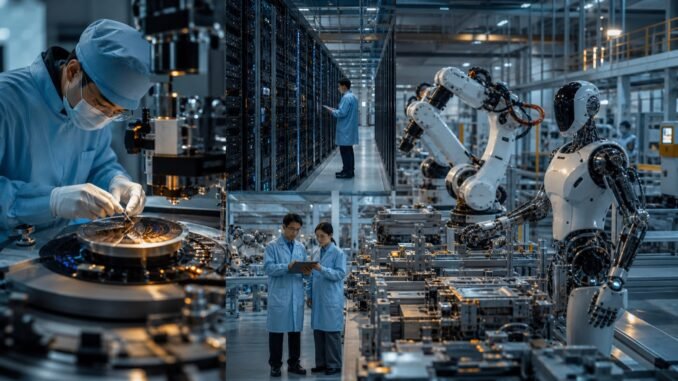
China’s artificial-intelligence contest is entering a more expensive and economically consequential phase. The most revealing developments are no longer confined to model benchmarks or consumer chatbots. They are appearing in cloud revenue, domestic computing hardware, factory software and robots that can operate in the physical world.
Results and capital-market activity this month sharpen that picture. Baidu said second-quarter revenue from AI cloud infrastructure rose 50% from a year earlier, while GPU cloud revenue increased 283%. Alibaba’s June-quarter results showed strong growth in AI-related cloud services alongside a sharp rise in capital expenditure. Unitree Robotics, meanwhile, used its Shanghai market debut to bring embodied AI—the combination of software, sensors and machines—into public-market focus.
The central investment question is therefore changing. China does not merely need a leading model developer. It needs companies that can connect models to computing capacity, industrial data, automation equipment and paying customers. The likely leaders will be those that control several of those layers—or occupy a bottleneck that the rest of the system cannot easily bypass.
Information in this article is current to 21 August 2026.
China’s AI opportunity is becoming an industrial system
China’s policy direction makes the shift explicit. An eight-agency “AI plus manufacturing” programme calls for deeper use of AI in the real economy. By 2027, it aims to put three to five general-purpose models into broad manufacturing use, create 1,000 high-level industrial agents, develop 100 industrial datasets and promote 500 representative applications.
These targets should not be treated as guaranteed commercial outcomes. They do, however, show where public support and procurement are likely to concentrate: industrial models, data, computing infrastructure, robotics and software that can improve production.
Shanghai has added more specific incentives. Its latest policy package offers support for industrial agents, physical AI, factory software, computing resources, data and AI-enabled equipment. The important point is not the subsidy amount alone. It is that policy is attempting to reduce the cost of adoption for manufacturers as well as the cost of developing technology.
That distinction matters. A capable model does not automatically become an industrial product. Factories need reliable data, integration with existing machinery, cybersecurity controls, predictable operating costs and clear responsibility when an automated system fails. The companies that solve those less glamorous problems may capture more durable value than those that merely attract attention with a new model release.
Alibaba and Baidu show where commercial demand is forming
Alibaba currently offers one of the clearest tests of the full-stack strategy. It combines the Qwen model family, a large public-cloud operation, proprietary computing hardware and access to enterprise and consumer ecosystems.
In the March quarter, Alibaba’s Cloud Intelligence Group revenue reached RMB41.6 billion, up 38% from a year earlier. External cloud revenue grew 40%, while AI-related products represented 30% of external cloud revenue. Its annual filing also said the cloud unit served about 67% of China’s A-share listed companies during the financial year.
The June quarter extended the underlying trend but exposed the cost. Alibaba reported a 45% rise in revenue from AI-related cloud and computing services to RMB48.4 billion, according to its latest results, while capital expenditure jumped 75% to RMB67.7 billion. Profit fell sharply.
For investors, that is both evidence of demand and a warning against confusing rapid adoption with immediate shareholder returns. Data centres, networking equipment and accelerators require heavy upfront spending. Returns depend on utilisation, pricing, customer retention and how quickly new capacity generates revenue.
Baidu’s economics are different but point in the same direction. The company reported RMB7.3 billion of AI cloud infrastructure revenue in the second quarter, up 50% year on year. Within that business, GPU cloud revenue rose 283%. AI applications revenue was much smaller at RMB2.5 billion and grew only 3%.
The contrast suggests that China’s near-term AI monetisation may be strongest in infrastructure and enterprise deployment rather than stand-alone applications. It also cautions against extrapolating one fast-growing segment into an equally strong result for the whole company. Baidu still has to manage the transition from its established internet business while funding cloud, models and autonomous driving.
Domestic compute is a strategic bottleneck—and an execution risk
China’s industrial AI ambitions face a basic constraint: computing capacity. Export controls and geopolitical uncertainty have increased the strategic value of domestic accelerators, memory, high-speed interconnects and the software needed to make heterogeneous hardware work together.
That creates opportunities for companies such as Huawei and emerging listed suppliers including Moore Threads, Biwin Storage, Huafeng Technology and Taclink Optoelectronics. Shanghai Stock Exchange reporting shows how demand is spreading across the stack. Moore Threads’ 2025 revenue rose 243% to RMB1.51 billion and increased a further 155% in the first quarter of 2026. The company also spent RMB1.31 billion on research and development in 2025—almost as much as its revenue.
Those figures illustrate the opportunity and the risk. Domestic substitution can produce exceptional growth from a low base, especially when policy and supply security favour local vendors. But it remains capital intensive, technically demanding and exposed to rapid product cycles. Revenue growth alone does not establish that a company has competitive performance, a mature software ecosystem or attractive long-term margins.
The competitive moat in AI hardware is rarely the chip in isolation. It includes developer tools, reliability, manufacturing access, networking, customer support and the cost of switching existing workloads. China can produce capable suppliers without every supplier becoming a durable winner.
Unitree brings AI into the physical economy
Unitree’s August listing made embodied AI the most visible new branch of the theme. The company sold 33,294 quadruped robots and 5,632 humanoid robots from 2023 through 2025, according to prospectus figures cited by the Shanghai Stock Exchange. Revenue increased from RMB159 million in 2023 to RMB1.70 billion in 2025, and overseas sales generated almost 44% of 2025 main-business revenue.
This is commercially more substantial than a laboratory demonstration. Yet humanoid robotics is still an early industry. The hardest questions concern reliability, safety, maintenance, useful working hours and the cost of completing a task relative to conventional automation or human labour.
Factories are controlled environments, which may make them the most credible early market. Industrial buyers can define repetitive tasks, redesign workflows and calculate a payback period. Household robots face more variable surroundings and less predictable economics.
Unitree’s strong debut therefore signals investor appetite, not proof that embodied AI has reached mass adoption. Its valuation will be sensitive to shipment growth, gross margins, warranty and service costs, export access, component supply and whether customers progress from pilot projects to repeat orders.
What separates an industry leader from an AI narrative
China’s emerging leaders can be assessed through four tests.
First is control of a bottleneck. A supplier with scarce computing capacity, widely adopted cloud infrastructure, critical industrial data or proven motion-control technology may have more pricing power than an easily replaced application.
Second is commercial evidence. Revenue from paying external customers, utilisation rates, repeat orders and cash generation matter more than model rankings, policy labels or pilot announcements.
Third is capital efficiency. Heavy investment can build a defensible position, but only if demand eventually supports adequate returns. Investors should compare capital expenditure and research spending with incremental revenue, margins and free cash flow.
Fourth is ecosystem depth. Industrial users want dependable systems, not isolated components. Companies that combine hardware, software, integration and service—or become indispensable partners within that chain—are better positioned to keep customers.
What to Watch
- Whether Alibaba’s new capacity produces sustained external cloud growth without an open-ended squeeze on cash flow.
- Whether Baidu converts GPU cloud momentum into broader revenue growth and stronger economics across its AI business.
- Whether domestic chip suppliers improve software compatibility and customer utilisation, rather than relying mainly on substitution demand.
- Whether Unitree and other robotics companies report repeat orders, service revenue and measurable factory productivity gains after initial deployments.
- Whether manufacturers adopt industrial agents at scale once subsidies and trial credits expire.
Finance World’s Read
China’s AI story is becoming broader and more tangible. Cloud revenue is growing, domestic computing suppliers are scaling and robotics is moving from private funding rounds into public markets. Policy is also pushing AI toward factories, equipment and industrial software, where productivity gains could have real economic value.
But the same transition raises the financial bar. Industrial AI needs expensive infrastructure, patient research spending and dependable deployment. The strongest companies will not necessarily be those with the loudest model launch or fastest early revenue growth. They will be those that turn a strategic bottleneck into repeat customer demand while earning acceptable returns on the capital required to build it.
For investors, the useful distinction is no longer simply between China and the United States, or between one model and another. It is between firms building an integrated industrial capability and firms whose valuations are running ahead of evidence that the capability can pay.
Sources
- Baidu: Second-quarter 2026 results
- Alibaba Group: Fiscal-year 2026 annual report
- Alibaba Group: March-quarter cloud and AI results
- Associated Press: Alibaba’s June-quarter results and AI investment
- China’s National Data Administration: “AI plus manufacturing” implementation plan
- Shanghai government: Support for AI in manufacturing
- Shanghai Stock Exchange: Unitree IPO and operating figures
- Shanghai Stock Exchange: Hard-tech AI suppliers’ results