Global Growth Is Holding Up, but the Winners Are Changing
The global economy is not sending a simple recession signal. It is also not sending a clean all-clear.
The International Monetary Fund’s July 2026 World Economic Outlook Update projects global growth of 3.0% in 2026 and 3.4% in 2027. That is a resilient headline given the pressure from higher energy costs, war-related disruption, tariff uncertainty and tighter financial conditions. But the more important message is beneath the headline: the expansion is becoming more uneven.
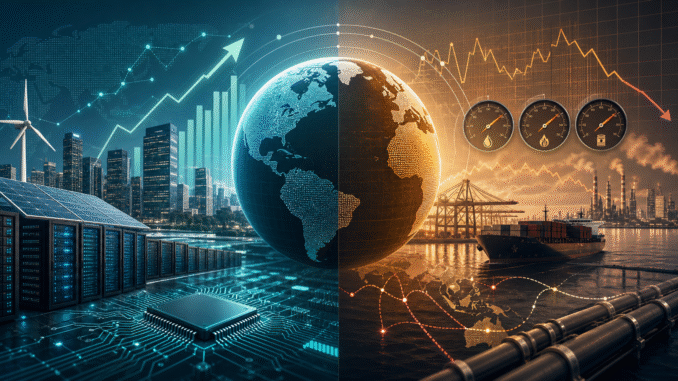
Some countries and companies are benefiting from the technology investment cycle, especially the buildout around artificial intelligence, semiconductors, data centers and digital services. Others are more exposed to expensive imported energy, higher transport costs, weaker trade volumes and stubborn inflation. For households and investors, the practical lesson is that broad growth numbers now hide larger differences across regions, sectors and balance sheets.
The Global Headline Still Looks Respectable
The IMF’s latest update says growth is holding up better than many feared. Its 3.0% global growth forecast for 2026 is not booming, but it is meaningfully above the kind of contraction that investors would associate with a global downturn.
That resilience matters. It suggests that employment, business investment and trade are still strong enough to absorb a large shock without the world economy immediately sliding into crisis. The IMF also expects growth to improve to 3.4% in 2027, implying that the fund sees the current drag as serious but not necessarily permanent.
Still, global aggregates can be misleading. A 3% world economy can feel very different depending on where the growth is coming from. If gains are concentrated in technology supply chains, energy exporters or higher-income consumers, then many businesses and households may still experience the environment as difficult.
That is why the phrase “resilient but uneven” is more useful than simply “strong” or “weak”.
AI Investment Is Acting Like a Shock Absorber
The most visible positive force is the technology investment cycle. The IMF says AI-driven demand is lifting countries integrated into the global technology value chain. The Federal Reserve’s July Monetary Policy Report makes a similar point for the United States, noting robust high-tech business investment and manufacturing strength connected to data-center demand and AI services.
This does not mean every AI-related stock, supplier or economy will win. It means the spending cycle is large enough to show up in macroeconomic data. Demand for chips, electronics, power equipment, data-center construction and related services can support industrial production, capital expenditure and exports even when other parts of the economy slow.
The World Trade Organization’s Goods Trade Barometer also points to this split. Its June reading showed global merchandise trade still above trend, with the electronic components index standing out above the common baseline. The WTO said the negative impact of the Middle East conflict may have been partly offset by demand for electronic components linked to AI investment.
For investors, that is a useful distinction. AI is not just a story about software valuations. It is increasingly a story about electricity, semiconductors, industrial equipment, land, cooling systems, construction, copper, grid capacity and financing. The beneficiaries may sit well outside the most obvious headline stocks.
Energy Prices Are the Main Drag
The offsetting force is energy. The IMF says global disinflation has stalled, while the World Bank’s June Global Economic Prospects release warned that Middle East conflict was pushing up energy prices, inflation and borrowing costs. The World Bank projected global growth slowing to 2.5% in 2026 under its June baseline, with Brent crude averaging $94 a barrel if the worst disruptions abated in July.
Forecasts differ because institutions use different assumptions and publication dates. The direction is consistent: energy has become a central risk to growth, inflation and policy.
Higher energy prices work through the economy in several ways. They raise direct costs for drivers, airlines, shippers and manufacturers. They can lift food prices through fertilizer and transport costs. They squeeze energy-importing countries more than energy exporters. They also make central banks less comfortable cutting interest rates because headline inflation becomes harder to ignore.
That matters for households because energy shocks are regressive. Lower-income families spend a larger share of their budget on essentials such as fuel, power and food. It matters for investors because the same shock can help energy producers while hurting transport, consumer discretionary spending and import-dependent businesses.
Inflation Has Not Been Fully Defeated
The Federal Reserve’s July report says U.S. PCE inflation rose 4.1% over the 12 months ending in May, while core PCE inflation rose 3.4%. It cited energy prices, earlier tariff increases and demand for AI-related high-tech products as contributors to price pressure.
That combination is uncomfortable. If inflation were only demand-driven, slower growth might cool it. If inflation were only a one-time energy spike, central banks might look through it more easily. But when energy, tariffs, supply constraints and strong investment demand all appear together, policy becomes harder.
The Fed has kept the federal funds target range at 3.5% to 3.75% since the start of the year. The OECD’s June outlook also described inflationary pressure from the energy shock and projected global GDP growth of 2.8% in 2026 under its central scenario, lower than its pre-conflict projection.
The takeaway is not that rates must rise everywhere. It is that rate cuts are less automatic when inflation is still above target. Borrowers should be cautious about assuming fast relief in mortgage, credit-card, business-loan or refinancing costs.
Trade Is Slower, but Not Broken
The WTO’s baseline forecast points to merchandise trade growth of 1.9% in 2026 and 2.6% in 2027, with commercial services trade growing faster. That is slower than the strong trade rebound of 2025, but it is still positive.
This is an important nuance. Global trade is not collapsing; it is being reshaped. AI-enabling goods are providing support. Services trade remains a bright spot. But energy disruptions, transport costs and policy uncertainty are making supply chains more complicated.
For businesses, this environment rewards flexibility. Firms with diversified suppliers, pricing power and strong logistics may handle volatility better. Firms that rely heavily on one shipping route, one input cost or one fragile customer segment may face more pressure.
For investors, it means country and sector selection matter more. A broad global index can hide very different exposures to energy imports, semiconductor demand, currency moves and borrowing costs.
What Readers Should Watch Next
The first indicator is oil and gas prices. A sustained drop would reduce inflation pressure and improve the case for easier policy. A renewed spike would do the opposite.
The second is whether AI investment stays broad enough to support more than a narrow group of companies. Watch capital spending, electricity infrastructure, semiconductor supply chains and industrial production, not just share prices.
The third is central-bank language. If policymakers keep emphasizing price stability, borrowers should expect financial conditions to remain tighter for longer. If inflation expectations stay anchored and energy prices cool, the conversation can shift.
The fourth is trade data. Stable trade growth would support earnings and manufacturing. A sharp slowdown would suggest the energy shock and policy uncertainty are biting harder.
Finance World’s Read
The global economy is absorbing a major shock better than expected, but the cushion is uneven. AI investment is helping, trade is still positive, and labor markets have not cracked. At the same time, energy prices and stalled disinflation are limiting the room for central banks to ease.
For households, the practical response is to budget for rates and essential costs staying elevated rather than assuming quick relief. For investors, the lesson is to look past the headline growth number and ask where the growth is actually coming from. In 2026, the winners are likely to be companies and economies with exposure to productive investment, resilient demand and manageable energy costs. The losers may be those depending on cheap fuel, easy money or broad consumer strength returning quickly.
This is still a growing world economy. It is just no longer growing evenly.
Reader Takeaways
- Global growth is still positive, with the IMF projecting 3.0% growth in 2026 and 3.4% in 2027.
- AI-linked investment is supporting parts of trade, manufacturing and capital spending.
- Energy prices remain the biggest risk because they affect inflation, household budgets and central-bank policy.
- Slower trade growth does not mean trade is collapsing, but sector and country exposure matter more.
- Borrowers and investors should avoid assuming that interest-rate relief will arrive quickly.
Sources
- International Monetary Fund, World Economic Outlook Update, July 2026: Global Economy in Crosscurrents of War and Technology
- Federal Reserve, Monetary Policy Report – July 2026 Summary
- World Bank, Global Economic Prospects June 2026 press release
- World Trade Organization, Goods trade holding up despite Middle East conflict and high energy prices
- OECD, Global economic outlook weakens amid energy shock and rising inflationary pressures