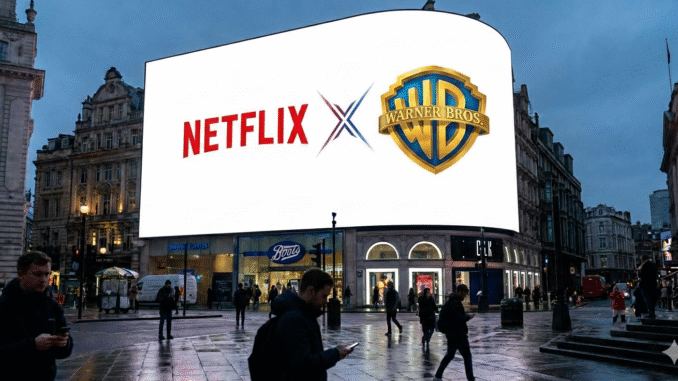
For years, the media industry has been defined by fragmentation: multiple streaming platforms battling for attention, legacy studios fighting to stay relevant, and consumers overwhelmed by rising subscription fatigue. But if Netflix were to acquire Warner Bros — a move that analysts have debated and speculated about — it would instantly become one of the most transformative deals in modern entertainment history.
This wouldn’t just be another consolidation. It would redefine content ownership, distribution power, and the global entertainment landscape.
1. Netflix Moves From Renting IP to Owning Hollywood
Netflix has spent over a decade building a vast library of original content — but the company’s Achilles heel remains the same: it does not own most of Hollywood’s most valuable franchises or legacy IP.
Warner Bros owns some of the heaviest hitters in entertainment:
- DC Universe (Batman, Superman, Joker)
- Harry Potter
- The Matrix
- Lord of the Rings (co-rights)
- Hundreds of iconic films and TV classics
With an acquisition, Netflix would shift instantly from a platform dependent on licensing deals to the world’s most powerful IP owner-operator.
This would fundamentally alter the content arms race — not by producing more shows, but by controlling stories and franchises that last decades.
2. Content, Distribution, and Data Under One Roof
The real power of the deal isn’t just the content library. It’s what Netflix can do with that content.
Netflix already has:
- The largest global streaming footprint
- World-class data analytics
- Sophisticated recommendation algorithms
- A proven content distribution machine
Warner Bros brings:
- A century of storytelling
- High-end film production infrastructure
- A legacy theatrical division
- Merchandising, licensing, and global branding
Together, this creates a vertically integrated entertainment empire.
Netflix could release a new Batman series globally, blend storylines across mediums, launch merchandise, push theatrical releases, and feed everything back into its streaming ecosystem — all with data-driven precision.
No traditional studio has this level of integrated digital reach. No streaming platform owns this calibre of IP.
3. The End of Streaming Fragmentation?
If the acquisition happens, the industry could experience a seismic shift.
Winners
- Consumers: One subscription with far more premium content.
- Netflix: Higher pricing power, lower churn, stronger global dominance.
- Investors: A business model anchored on intellectual property rather than constant spending.
Losers
- Competing streamers (Disney+, Amazon, Paramount+): They instantly become smaller players.
- Cable networks: Lose even more of their last remaining leverage.
- Theatrical exclusivity: Netflix could accelerate hybrid releases or global day-one drops.
The deal could trigger a domino effect, forcing more mergers as rivals scramble to protect their libraries and distribution channels.
4. A Deal With Global Consequences
This wouldn’t just be a Hollywood story. The ripple effects would hit:
• Technology
Streaming platforms might need to reinvent their tech stack to compete with Netflix’s scale.
• Advertising
Netflix’s ad-supported tier becomes exponentially more valuable if it controls blockbuster franchises.
• International Markets
Local studios and broadcasters may face unprecedented pressure as global IP becomes centralized under one platform.
• Media Regulation
Antitrust watchdogs in the US and EU would likely scrutinize the deal heavily.
But given the speed of digital disruption, regulators may struggle to define clear boundaries in a rapidly evolving landscape.
5. Risks: Why the Deal Could Still Go Wrong
Even if the acquisition closes, Netflix faces real challenges:
- Integration complexity: Warner Bros is a 100-year-old studio with legacy contracts and union structures.
- Cultural clashes: Netflix’s data-driven culture vs. Hollywood’s creative tradition.
- Debt and financing: This would be one of the most expensive acquisitions in media history.
- Political pressure: Regulators may fear a content monopoly.
But despite the risks, the strategic upside is hard to ignore.
The Bottom Line
If Netflix buys Warner Bros, it wouldn’t just expand its content library.
It would rewrite the rules of entertainment.
For the first time in history, one company would have:
- World-class storytelling
- Global distribution
- Direct access to billions of viewers
- A unified data-powered content ecosystem
- Control over some of the biggest fictional universes ever created
This isn’t just a corporate acquisition.
It would be a media super-merger capable of reshaping Hollywood, streaming, global content consumption — and the future of entertainment itself.