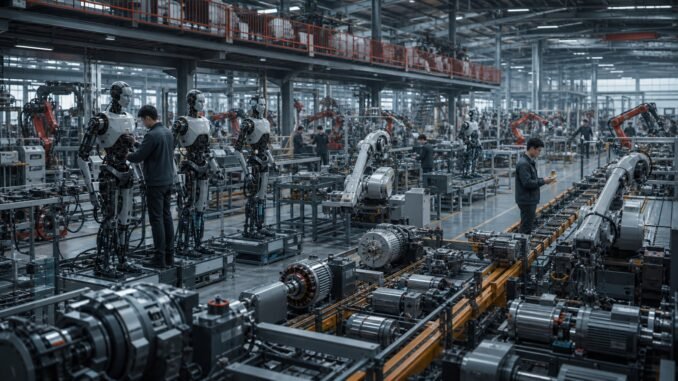
China’s robotics advantage is no longer mainly a story about ambitious prototypes. It is becoming a story about industrial scale.
The International Federation of Robotics says China installed 295,000 industrial robots in 2024, a record and 54% of the global total. More than two million industrial robots were operating in Chinese factories by year-end. For the first time, Chinese suppliers also sold more robots than foreign companies in their home market, taking a 57% share of new installations.
Those figures do not prove that China will lead every part of robotics. Industrial arms are not humanoids, installed units do not reveal profitability, and a large domestic market does not guarantee global acceptance. But they identify the mechanism that could make China unusually difficult to dislodge: it can manufacture robots at scale, deploy them across the world’s largest industrial ecosystem, learn from that deployment and feed the lessons back into the next generation of machines.
Information and policy developments in this article are current as of 23 August 2026.
The Advantage Starts With Deployment
Robotics improves through use. A machine that welds, sorts, inspects or moves materials in a real factory produces operational knowledge that a laboratory demonstration cannot: failure rates, maintenance needs, cycle times, safety constraints and the economics of replacing or assisting human labour.
China has more opportunities to generate that knowledge than any other country. Its 2024 installations were larger than the rest of the world’s major markets combined, while its operational stock passed two million units. Its manufacturing robot density reached 567 robots per 10,000 employees, according to the IFR—behind South Korea and Singapore, but ahead of Germany and Japan.
This matters because China is not merely buying automation to compensate for higher wages or an ageing workforce. It is building a domestic test bed spanning automotive plants, electronics assembly, metalworking, machinery, logistics and increasingly more flexible production tasks.
A large installed base creates recurring demand for integrators, software, sensors, maintenance, tooling and replacement parts. It also gives suppliers more chances to identify where robots fail and where customers will actually pay for improvement.
China Is Closing the Supplier Gap
For years, China’s position as the largest robot buyer coexisted with substantial dependence on foreign suppliers. The balance is changing.
Chinese manufacturers supplied 57% of industrial robots installed domestically in 2024, up from roughly 28% across the previous decade, according to the IFR. That shift suggests local companies are moving beyond low-cost imitation and winning more demanding factory orders.
Official production data point in the same direction. China’s National Bureau of Statistics recorded output of 773,000 industrial robots in 2025, up 28% from 2024. That figure is not directly comparable with IFR installations: the agencies use different definitions and one measures production while the other tracks deployments. Read together, however, the series show both strong demand and rapidly expanding supply.
This is the core of China’s potential advantage. The country already has dense supply chains for electric motors, batteries, power electronics, machine tools, cameras, sensors and precision components. Many of these capabilities were built for electric vehicles, consumer electronics and industrial equipment, but they can be adapted to robots.
The result can be a familiar manufacturing loop: higher volumes reduce component costs; lower costs broaden adoption; broader adoption produces more operating data; and that data helps manufacturers improve designs and production processes.
Humanoids Could Benefit—But They Are Not the Whole Story
Humanoid robots receive disproportionate attention because they resemble people and promise to work in environments designed around the human body. China has made the field a policy priority. The Ministry of Industry and Information Technology’s 2023 guidance called for an initial innovation system and breakthroughs in “brain”, “cerebellum” and limb technologies by 2025, with an internationally competitive industrial ecosystem by 2027. The 2025 Government Work Report also identified embodied intelligence and intelligent robots as future industries.
Policy support can accelerate research, standards, procurement and factory construction. China’s strength in batteries, actuators, electronics and high-volume assembly could also lower the hardware cost of humanoid machines faster than competitors expect.
Yet the robotics era will not be won by appearance. Most economically useful robots may remain specialised: arms that weld, autonomous vehicles that move pallets, systems that inspect power lines, or machines designed for warehouses, hospitals and farms.
The winning platform will be the one that performs valuable work reliably and safely at an acceptable total cost. That includes maintenance, energy, integration, supervision and downtime—not merely the purchase price.
The Constraints Are Substantial
China’s scale case is strong, but dominance is not preordained.
First, advanced robotics depends on more than hardware. Perception, planning, simulation, foundation models, specialised chips and developer software can determine whether a machine is adaptable or brittle. China has strong AI research and a vast engineering base, but access to some advanced semiconductors and manufacturing equipment remains affected by export controls and geopolitical fragmentation.
Second, commercial demand for general-purpose humanoids is still uncertain. A compelling demonstration does not establish that a robot can work safely for thousands of hours, adapt to unstructured environments and deliver a return on investment. Excess capacity and intense price competition could produce impressive shipment growth while destroying supplier margins.
Third, global markets may fragment. Governments and companies could restrict Chinese-connected robots in sensitive facilities because mobile machines combine cameras, microphones, wireless links, software updates and physical access. Cybersecurity, data governance and national-security concerns may matter as much as price.
Fourth, standards and liability remain unsettled. As robots operate closer to people, manufacturers and users will need clearer rules covering safety, accountability, data use and insurance. A serious accident or cyber incident could slow deployment across the industry.
Finally, leadership in unit volume does not necessarily translate into control of the most profitable layers. Software platforms, critical components, intellectual property and after-sales services may capture more durable economics than final assembly. Investors should distinguish industrial leadership from shareholder returns.
Who May Be Affected
Manufacturers worldwide face both an opportunity and a competitive threat. Cheaper, more capable automation could reduce unit costs and help factories cope with labour shortages. But Chinese producers may also compress equipment prices and challenge established Japanese, European and American suppliers.
Workers are likely to experience uneven effects. Robots can remove dangerous and repetitive tasks and raise productivity, but they can also reshape employment in assembly, logistics and inspection. The practical outcome will depend on how quickly companies redesign work and invest in training, maintenance and process engineering.
For investors, the theme extends beyond headline humanoid brands. Potential value may sit in actuators, reducers, sensors, industrial software, machine vision, testing, power electronics and factory integration. The risk is paying technology multiples for businesses whose products become commoditised before profits mature.
What to Watch
Several indicators will show whether China converts scale into durable leadership:
- Domestic supplier share: Continued gains would suggest Chinese firms are moving up the performance curve, not merely adding capacity.
- Deployment outside showcase projects: Repeat orders in factories, warehouses and service environments matter more than demonstrations.
- Reliability and total cost: Hours between failures, maintenance expense and measurable labour or throughput gains will reveal the real economics.
- Export acceptance: Security rules, tariffs and procurement restrictions will determine how much of China’s cost advantage travels abroad.
- Software and component independence: Progress in chips, operating systems, actuators and precision reducers will show whether the ecosystem controls critical bottlenecks.
- Industry profitability: Falling prices are helpful for adoption but dangerous if they produce persistent losses and consolidation.
Finance World’s Read
China may dominate the robotics era because it possesses the ingredient that mattered in electric vehicles and solar equipment: a huge production base connected to a huge deployment market.
That combination can turn factories into both customers and learning systems. It can accelerate cost reduction, expose weaknesses quickly and support a dense network of component makers and integrators.
But the strongest claim the evidence supports is conditional. China is well placed to lead robotics manufacturing and deployment; it has not yet proved that it will control the most valuable software, achieve reliable general-purpose autonomy or overcome political barriers in overseas markets.
The robotics race will be decided less by which machine performs the most impressive demonstration than by which ecosystem can make useful machines work, repeatedly and profitably, in the real economy. On that test, China begins with a formidable advantage.
Sources
- International Federation of Robotics: World Robotics 2025
- International Federation of Robotics: China industrial robot market, 2025 release
- International Federation of Robotics: World robot density, 2025 report foreword
- National Bureau of Statistics of China: 2025 national economic and social development communiqué
- Ministry of Industry and Information Technology: Humanoid Robot Innovation and Development Guidance
- State Council of China: 2025 Government Work Report priorities
This article is for general information and education. It does not constitute personalised investment advice.