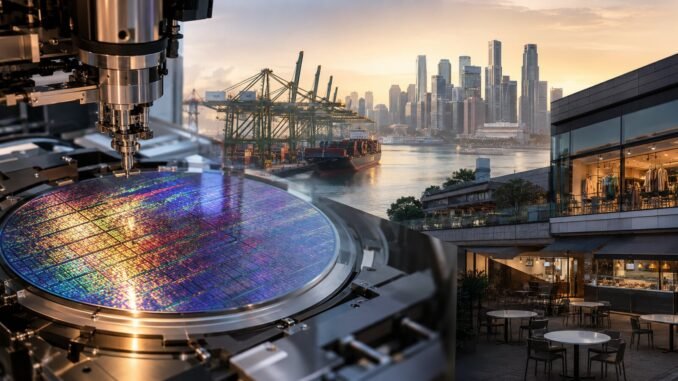
Singapore’s economy has delivered a much stronger first half than expected. The Ministry of Trade and Industry (MTI) now expects real GDP to grow 4.5%–5.5% in 2026, sharply above its previous 2.0%–4.0% forecast, after output expanded 5.9% year on year in the second quarter and 6.1% across the first half.
The upgrade is significant, but the detail matters more than the headline. Singapore is benefiting from a powerful global artificial-intelligence investment cycle that is lifting semiconductor production, precision engineering, technology wholesale trade and selected financial services. At the same time, several consumer-facing sectors remain comparatively soft, while higher energy costs and trade uncertainty still threaten the second-half outlook.
The central question is therefore not whether Singapore is growing. It is whether the technology-led surge can broaden into a more balanced expansion that businesses and households feel more evenly.
Information in this article is current as of 11 August 2026.
The Upgrade Reflects More Than a Statistical Surprise
Second-quarter GDP grew 1.4% from the previous quarter on a seasonally adjusted basis, extending the first quarter’s 1.2% gain. That consecutive quarterly expansion strengthens the case that the first-half performance was not merely a flattering year-on-year comparison.
Manufacturing was the clearest engine. The sector expanded 12.5% year on year and 6.3% quarter on quarter, reversing its first-quarter contraction. Electronics and precision engineering led the advance as demand rose for networking and memory chips used by data centres, along with equipment required for semiconductor capacity expansion.
The same cycle spread into other parts of the economy. Wholesale trade grew 8.3% year on year, supported by telecommunications equipment, computers and electronic components. Information and communications grew 5.0%, while finance and insurance expanded 6.2% as banks benefited from credit growth and fee-generating activity.
This breadth across manufacturing, trade, digital services and finance explains why MTI is more confident than it was in May. Yet much of that breadth still traces back to a common source: global technology capital expenditure.
Strong Growth, but an Uneven Economy
The second-quarter data show a notable divide between outward-facing sectors and parts of the domestic consumer economy.
Retail trade grew only 1.0% year on year and fell 2.2% from the previous quarter. Food and beverage services contracted 1.5% year on year and 2.8% quarter on quarter. Accommodation growth slowed to 2.2% year on year and the sector contracted 4.6% from the first quarter.
Those numbers do not negate the strength of the overall economy. They do show that a high GDP growth rate can coexist with weaker conditions in businesses that depend directly on local discretionary spending and visitor activity.
The distinction matters for households as well. Singapore’s consumer price index rose 1.9% year on year in June, while the Monetary Authority of Singapore expects both core and headline inflation to average 1.5%–2.5% in 2026. Inflation is far below the peaks seen earlier in the decade, but elevated energy and imported input costs could keep pressure on transport, utilities, food distribution and business margins.
For consumers, the economy may therefore feel less buoyant than the headline GDP number suggests. The direct benefits of an export and capital-equipment boom are concentrated first in firms, workers and investors tied to the technology, trade, logistics and financial ecosystems. Broader gains depend on how far those benefits spread through hiring, wages, supplier demand and investment.
The AI Cycle Is a Genuine Tailwind—and a Concentration Risk
Singapore occupies valuable positions in the global semiconductor and technology supply chain. It produces specialised chips, supports equipment manufacturing, handles regional trade and financing, and hosts data-centre and enterprise-technology activity. When global AI capital expenditure accelerates, these capabilities can reinforce one another.
That is a structural advantage, not simply a temporary export spike. But it also makes the outlook unusually sensitive to the durability of technology investment.
MTI identifies a sudden deterioration in financial-market sentiment toward global AI spending as one of the major downside risks. If technology companies reduce capital budgets, data-centre construction slows or semiconductor customers work through excess inventory, the same supply-chain linkages that amplify growth can transmit a downturn.
The current forecast therefore embeds an important assumption: AI-related capital expenditure remains strong through the rest of 2026. The evidence presently supports that view, but it is a condition rather than a certainty.
Energy and Trade Risks Have Not Disappeared
The stronger forecast also reflects the fact that the economic damage from the Middle East conflict has so far been less severe than feared. Alternative energy supplies and inventory drawdowns have limited the rise in global energy prices.
However, MTI cautions that disrupted energy and intermediate-input flows could keep costs elevated in the second half. Singapore’s chemicals cluster is already suffering from crude-oil and feedstock disruptions, while higher fuel costs could weigh on aviation, shipping and tourism.
Trade policy is another risk. Additional US tariff measures could weaken confidence, investment and spending across affected economies. Singapore may not be the primary target of many restrictions, but its openness means it is exposed to slower regional trade, supply-chain disruption and weaker demand from major partners.
The upgraded forecast is therefore not a declaration that external risks have vanished. It is a judgment that the technology upswing currently outweighs them.
What It Means for Investors, Businesses and Households
For investors, Singapore’s stronger growth supports the operating backdrop for banks, technology-linked manufacturers, logistics providers and selected industrial businesses. But the quality of exposure matters. A company benefiting from the AI cycle may still face customer concentration, high capital requirements, volatile orders or an expensive valuation.
For businesses, the outlook is two-speed. Firms serving semiconductor, data-centre, finance and regional trade demand may see stronger pipelines. Consumer-facing companies may continue to face cautious spending, travel leakage and cost pressure. Planning around the headline GDP forecast alone could therefore be misleading.
For households, the key issue is transmission. A stronger economy becomes more meaningful when it produces sustained employment demand, real wage gains and confidence beyond a narrow group of sectors. Inflation remaining contained within the official forecast range would help those gains translate into purchasing power.
What to Watch Next
Four signals will determine whether the upgraded outlook becomes more balanced:
- Electronics and precision-engineering orders: Continued strength would support the upper end of MTI’s forecast; weaker orders would expose the economy’s dependence on the AI cycle.
- Retail and food-services volumes: Improvement would show that growth is reaching domestic demand rather than remaining concentrated in external sectors.
- Inflation and energy costs: A fresh energy-price shock could squeeze households, margins and policy flexibility.
- Hiring and wage growth: Broader labour-market gains would be the clearest sign that export strength is spreading through the economy.
Finance World’s Read
Singapore’s outlook has improved decisively. Consecutive quarterly growth, a 6.1% first-half expansion and strength across manufacturing, wholesale trade, information services and finance justify MTI’s substantial forecast upgrade.
But the composition of growth calls for measured optimism. The economy is riding a strong and credible AI investment wave, while the domestic consumer picture is softer and external risks remain material.
The most useful way to read the 4.5%–5.5% forecast is not as an all-clear signal. It is evidence that Singapore’s technology and trade capabilities are capturing an important global investment cycle. The next test is whether that strength becomes durable enough—and broad enough—to lift more sectors, incomes and household confidence.
Sources
- Ministry of Trade and Industry: 2026 GDP forecast upgrade and second-quarter performance
- Ministry of Trade and Industry: Economic Survey of Singapore, Second Quarter 2026
- Monetary Authority of Singapore: Monetary Policy Statement, July 2026
- Singapore Department of Statistics: Consumer Price Index, June 2026
This article is for general informational purposes only and does not constitute investment, financial or other professional advice.