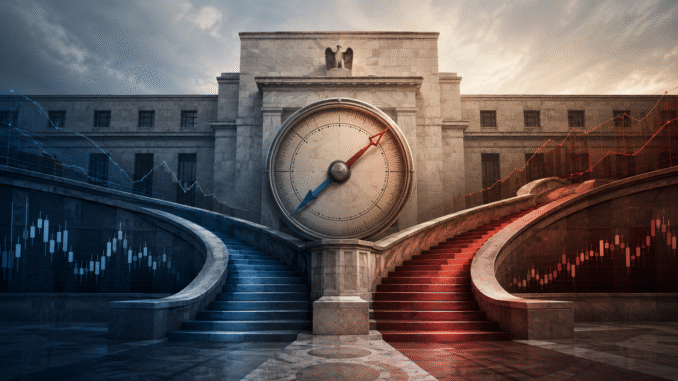
The Federal Reserve has reached an uncomfortable middle ground: inflation is still too high for policymakers to declare victory, while the labor market is now soft enough to make additional tightening look increasingly risky.
At its July meeting, the Federal Open Market Committee kept the federal-funds target range at 3.5% to 3.75%. The decision passed by a 9–3 vote, an unusually divided outcome that underlined how wide the policy debate has become. For investors, the practical message is not that a rate cut or increase is imminent. It is that the next move will depend heavily on which risk—persistent inflation or weakening employment—becomes more urgent.
The case for rate cuts is getting stronger
July's employment report gave the doves their clearest argument. Nonfarm payrolls fell by 23,000, while the unemployment rate held at 4.1%. One negative payroll reading does not establish a recession, and the unemployment rate remains low by historical standards. Even so, the report suggests that the labor market no longer has the same capacity to absorb restrictive monetary policy without damage.
That matters because interest-rate changes work with a lag. The Fed is not deciding merely whether today's economy can tolerate current rates; it must judge what those rates will do to hiring, credit demand, housing and business investment over the next several quarters.
A broader weakening in payrolls, a rise in unemployment or a pullback in consumer spending would make cuts easier to justify. Under that scenario, the Fed could frame an initial reduction not as an emergency response, but as a recalibration: removing some restraint as growth slows while keeping policy tight enough to continue pressuring inflation.
For markets, this would generally support shorter-maturity bonds first. Equities could also benefit from lower discount rates, although the reason for the cut would matter. A gradual, preventive easing cycle is friendlier to risk assets than aggressive cuts prompted by a sharp economic downturn.
The case for renewed hikes has not disappeared
The difficulty is that inflation remains well above the Fed's 2% objective. The personal consumption expenditures price index—the Fed's preferred inflation gauge—was 3.7% higher in June than a year earlier. Core PCE, which excludes food and energy, rose 3.3% over the same period.
Monthly data offered some relief: headline PCE fell 0.1% in June and core PCE increased only 0.1%. But one encouraging month does not establish a durable trend, particularly after several months in which inflation remained sticky. June consumer prices were still 3.5% higher than a year earlier, with energy prices adding pressure.
This is why another increase remains a plausible tail risk. If inflation reaccelerates, inflation expectations rise, or tariff- and energy-related price pressures spread into services and wages, the Fed may conclude that holding rates steady is insufficient. The three dissenting votes at the July meeting show that the threshold for discussing tighter policy is not merely theoretical.
A renewed hiking cycle would be more disruptive for markets because investors are generally more prepared for eventual easing than for another turn upward. Long-duration growth stocks, highly leveraged companies and rate-sensitive property assets would be particularly exposed. Cash and short-term instruments could regain appeal, while longer-term bond yields might rise unless investors interpreted the hikes as creating a later recession risk.
The most likely path: a longer hold, then conditional easing
The current data argue for patience. Inflation is too elevated to make rapid cuts comfortable, but the labor market is too soft to make further increases the obvious choice. The most defensible base case is therefore an extended hold, with cuts more likely than hikes as the next move—but only if inflation continues to cool or labor conditions weaken further.
The next major checkpoint is the July consumer-price report, due on August 12. Investors should look beyond the headline number. The composition of inflation will matter: persistent services inflation would worry the Fed more than a temporary change driven by volatile energy prices. Wage growth, payroll revisions, unemployment claims and consumer spending will also help determine whether July's job weakness was noise or the start of a broader slowdown.
Markets may still move sharply around each release because policy expectations are finely balanced. That volatility is a reason to avoid building a portfolio around a single confident rate forecast.
What general investors can do
First, separate the direction of rates from the reason they move. Cuts caused by falling inflation and steady growth are different from cuts caused by a recession. The former can support both stocks and bonds; the latter may initially favor high-quality bonds over economically sensitive equities.
Second, reduce unnecessary concentration in assets that depend on one rate outcome. A mix of cash or short-term government securities, high-quality bonds and diversified equities can provide more resilience than a large bet on long-duration stocks or a single bond maturity.
Third, pay attention to refinancing exposure. Companies and property vehicles with substantial near-term debt maturities remain vulnerable if rates stay higher for longer. Strong balance sheets and reliable cash flow are especially valuable in a policy environment where both cuts and hikes remain possible.
The Fed is not choosing between an easy and a hard decision. It is choosing between two risks that are moving in opposite directions. For investors, the sensible conclusion is not to predict every meeting. It is to prepare for a wider range of outcomes.
Sources
- Federal Reserve: FOMC statement, July 29, 2026
- Federal Reserve: 2026 FOMC meeting calendar and materials
- U.S. Bureau of Economic Analysis: Personal Income and Outlays, June 2026
- U.S. Bureau of Labor Statistics: Employment Situation, July 2026
- U.S. Bureau of Labor Statistics: Consumer prices through June 2026
- U.S. Bureau of Labor Statistics: CPI release schedule
This article is for general information and educational purposes only. It does not constitute financial, investment, tax or legal advice. Investing involves risk, including possible loss of principal.