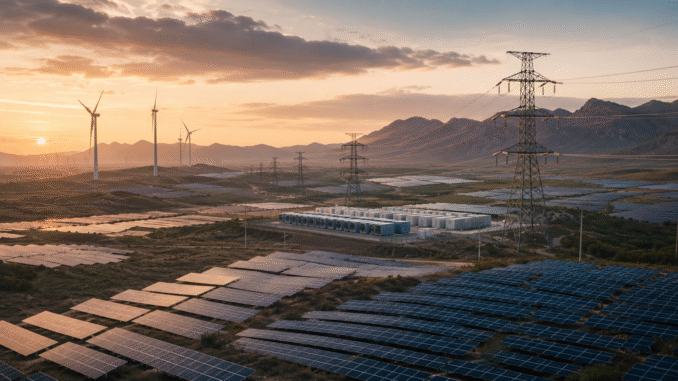
China's renewable-energy industry has crossed a threshold that once looked distant. At the end of June 2026, the country had 2.455 terawatts of renewable generating capacity, equal to 60.7% of its entire power fleet. Wind and solar alone reached 1.951 terawatts, while solar capacity was almost level with coal-fired capacity. In the first half of the year, renewables supplied about 40% of China's electricity and accounted for nearly three-quarters of all new capacity.
Those figures describe more than a construction boom. They show a power system being rebuilt at industrial scale. Yet for investors, developers and equipment makers, the decisive change is not the headline volume. It is the shift from a policy model that rewarded deployment to one that increasingly rewards flexibility, grid access and commercially reliable output.
A new plan, and a higher starting point
China's Renewable Energy Development Plan for the 15th Five-Year Plan period, released in July, sets a 2030 target of about 3.5 terawatts of renewable capacity. Wind and solar are to exceed 2.8 terawatts and generate more than 4,000 terawatt-hours a year. Total renewable generation is targeted at roughly 6,000 terawatt-hours.
The ambition matters, but so does the baseline. China ended 2025 with about 2.34 terawatts of renewable capacity, including 1.84 terawatts of wind and solar. Reaching the 2030 targets therefore requires continued additions on a scale that would still dwarf most national power systems, even if annual growth moderates from the extraordinary pace of recent years.
The plan also broadens the definition of growth. It calls for 160 gigawatts of pumped-storage hydropower by 2030 and seeks to make new large wind and solar projects more system-friendly, including a principle that new centralized projects should provide at least 10% dependable capacity. That language points directly to the next capital cycle: batteries, pumped hydro, grid-forming equipment, forecasting software, demand response and long-distance transmission.
From guaranteed expansion to market discipline
A second policy shift is already changing project economics. Under the renewable power-pricing reform announced in February 2025, electricity from wind and solar is being brought more fully into market trading. Prices are increasingly formed through transactions rather than administratively guaranteed tariffs, while settlement mechanisms are intended to provide a measure of long-term revenue stability. Existing and new projects are treated differently.
For the industry, this is both a risk and a maturation signal. Developers can no longer assume that capacity alone produces an attractive return. Project value will depend more heavily on when and where electricity is generated, the strength of the local grid, exposure to low or negative prices, curtailment, contractual protection and the ability to pair generation with storage or flexible demand.
This is particularly important because China's resource map and demand map do not always align. Many of the best wind and solar resources are in the north and west, while major load centers sit along the eastern and southern coasts. Ultra-high-voltage transmission, interprovincial trading and regional market coordination are therefore not supporting details; they are core infrastructure for monetizing renewable assets.
The investment opportunity moves downstream
The most obvious winners of China's first renewable boom were solar-module, inverter and wind-turbine manufacturers. That manufacturing base remains globally important, but intense competition and excess capacity have compressed prices and margins across parts of the supply chain. Scale is no longer a sufficient investment thesis.
The stronger opportunities may now sit one layer downstream. Storage developers can arbitrage increasingly variable prices and help generators meet grid requirements. Transmission and distribution investment can unlock constrained regions. Digital platforms can optimize dispatch across batteries, industrial loads, electric vehicles and distributed solar. Green-power contracts and certificates can help exporters document lower-carbon production as global supply chains face tighter carbon-accounting rules.
Distributed solar also remains strategically relevant. It reduces the need to move every unit of electricity across long distances and can be paired with industrial demand. China's green-power direct-connection policy, issued in 2025, creates a framework for renewable projects to supply identifiable customers more directly, potentially supporting industrial parks, data centers, hydrogen production and export-oriented manufacturers seeking verifiable clean electricity.
The constraints investors should not ignore
The scale of the opportunity does not remove the industry's structural risks. First, utilization matters more than capacity. A gigawatt connected in a congested province or during hours of abundant solar supply can earn less than a smaller asset located closer to demand or paired with storage.
Second, policy implementation varies by province. China's national direction is clear, but detailed market rules, settlement mechanisms and grid-connection practices can differ materially. Investors must evaluate provincial economics rather than treating China as a single electricity market.
Third, coal has not disappeared. It still provides system security and, in the first half of 2026, generated just under half of China's electricity. New thermal capacity can coexist with rapid renewable additions, especially where planners prioritize reliability during extreme weather or demand peaks. The transition is therefore best understood as a contest over utilization and generation share, not simply installed capacity.
Finally, manufacturers face geopolitical and trade exposure. China's cost advantages have accelerated renewable deployment worldwide, but tariffs, local-content rules and supply-chain security policies can limit access to overseas markets. Domestic volume may remain large without guaranteeing strong margins for every producer.
What to Watch
Watch three indicators to judge whether capacity is turning into economic value. The first is renewable utilisation: rising curtailment or falling operating hours would suggest that new projects are outrunning grid and storage investment. The second is provincial implementation of market-based pricing, including how settlement mechanisms protect project revenues when spot prices weaken. The third is the pace of transmission, pumped-hydro and battery deployment relative to wind and solar additions.
Investors should also watch the gap between equipment shipments and manufacturer profitability. Continued volume growth alongside weak pricing would favour buyers and project developers but leave upstream returns under pressure. A stabilisation in pricing, inventory and capital expenditure would strengthen the case that the supply chain is moving toward a more sustainable balance.
Finance World's Read
China has already demonstrated that it can manufacture and install renewable capacity faster than any other country. The harder test is whether it can operate that capacity as a flexible, market-responsive and financially durable power system.
The new five-year plan suggests policymakers understand that challenge. Its emphasis on dependable output, storage, grid integration, direct supply and market-based pricing moves the sector beyond a simple build-out story. The next phase may offer fewer easy gains from volume, but more durable opportunities in the infrastructure and services that make renewable electricity usable when and where it is needed.
China's renewable-energy boom is not ending. It is becoming more selective – and the distinction between installed capacity and economic value will matter more than ever.
Sources
- National Energy Administration: H1 2026 renewable-energy operating data
- National Energy Administration: H1 2026 national energy situation
- National Development and Reform Commission: renewable power-pricing reform
- National Development and Reform Commission: green-power direct connections
- State Council: carbon-peaking action plan for 2026-2030
- International Energy Agency: Renewables 2025
This article is for general information and educational purposes only. It does not constitute financial or investment advice.